
When Can Babies Use a Spoon and How Do You Teach Them
 When Can Babies Use a Spoon and How Do You Teach Them
Most parents introduce a spoon around six months when solids begin, hand over their first baby spoon, and watch their baby stare at it blankly before slapping it against the high chair tray.
That's normal. Self-feeding with a spoon is a skill that develops over months, not days. Understanding what's actually happening developmentally and having the right spoon for each stage makes the whole process significantly less frustrating for everyone.
When can babies start using a spoon?
Babies can be introduced to a spoon from around six months, when most begin starting solids. At this stage, they won't be feeding themselves; the spoon is more of an exploration tool. They'll mouth it, wave it around, and occasionally let you guide food into their mouth with it.
Meaningful self-feeding typically begins between nine and twelve months, when hand-eye coordination improves enough for a baby to get food from bowl to mouth with some reliability. Expect a little bit of mess at this stage.
By around twelve months, many toddlers are managing meals largely independently, and by eighteen months, most have solid spoon control across a range of foods.
The key point: don't wait until they're "ready" to introduce a spoon. Early exposure, even just letting them hold one while you feed them, builds familiarity and accelerates the learning process.
Why self-feeding matters more than most parents realise
Handing a baby a spoon feels chaotic. It's faster and cleaner to just feed them yourself. But there are real developmental reasons to let babies work at it from early on.
Self-feeding builds fine motor skills, hand-eye coordination, and the pincer grip that children need for writing later on. It also builds independence and confidence at the table. Research, including from the Australian Better Health Channel, suggests that babies introduced to a variety of textures and encouraged to self-feed early tend to develop a more positive relationship with food and are less likely to become fussy eaters.
Occupational therapists consistently recommend offering babies the opportunity to self-feed from the start of solids, even if most of the actual food delivery still comes from a parent in the early months.
The two-spoon approach
One of the most practical techniques for early spoon feeding is the two-spoon approach: you keep one spoon loaded and ready to feed your baby, and your baby has their own spoon to hold, explore, and attempt to use.
This works because babies at six to nine months have a strong urge to grab whatever you're holding. If they already have a spoon in their hand, they're less likely to grab yours mid-scoop. It also gives them constant practice holding and manoeuvring a spoon without the pressure of actually having to deliver food with it.
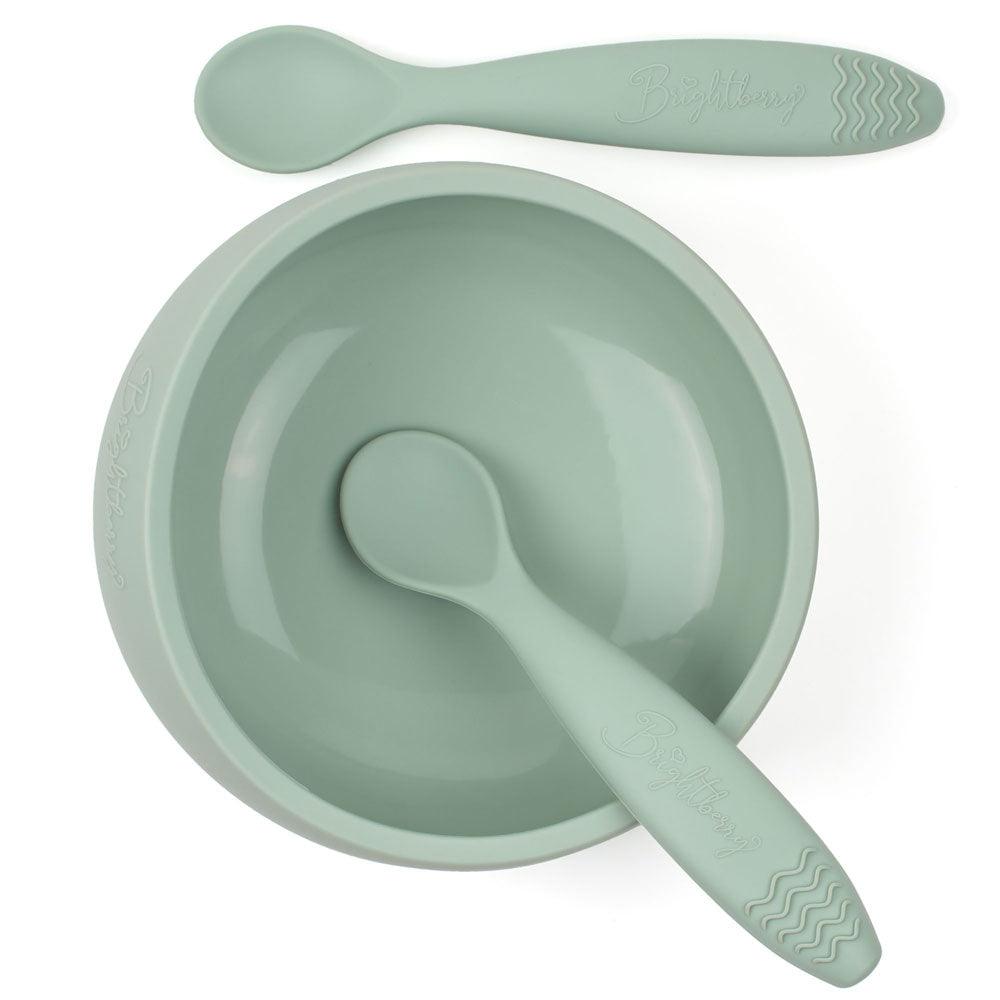
The Brightberry silicone baby spoons come as a set of two specifically for this reason, and it's the same thinking behind why the Suction Bowl Set includes two spoons rather than one.
What makes a good baby spoon
Not all baby spoons support self-feeding equally. Here's what actually matters.
The tip should be soft.
Babies are teething for most of the period when they're learning to spoon-feed. Gums are already tender, so a soft tip makes the spoon more comfortable and less likely to be associated with discomfort. This rules out metal spoons for babies. They are hard, cold, and unforgiving against sore gums and emerging teeth.
Plastic is widely used, but worth thinking about.
Plastic spoons are everywhere and simple to find. The consideration is that plastic is harder against tender gums, and once babies start biting, which happens right in the middle of the self-feeding learning stage, those teeth scratch the plastic surface. Scratches harbour bacteria, and with warm food, plastic can release microplastics. It's also worth knowing that "BPA-free" labelling doesn't necessarily mean free from similar chemicals: research shows manufacturers often replace BPA with alternatives like BPS or BPF, which are under increasing scientific scrutiny. Parents are increasingly choosing to avoid plastic for baby feeding products altogether.
Silicone is a better material, but not all silicone spoons work equally well.
Silicone is soft, gentle on gums and teeth, and free from BPA, PVC, and phthalates. The consideration with silicone is that it's naturally very flexible, but a spoon without any internal structure can bend under the resistance of a thick puree and fling food sideways rather than scooping it. Most basic silicone spoons have this problem, which is why babies (and parents) get frustrated early.
A reinforced handle makes the difference.
A silicone spoon with a rigid internal core gives the structure needed to scoop properly while staying soft and safe on the outside. The core material matters: a metal rod can eventually work through the silicone, which is a safety concern. A nylon core achieves the same rigidity without that risk.
Handle shape matters for little hands.
Babies grip a spoon in their fist from above, not the way adults hold one. A wide, arched handle that fits a fist grip and allows for that overhead approach gives babies a far better chance of scooping successfully.

Silicone vs metal vs plastic baby spoons
Silicone is the best material for babies learning to self-feed. It's soft against gums and emerging teeth, safe if bitten hard, easy to clean, and free from BPA and other chemicals found in plastic. The grade matters, though: LFGB-certified silicone is the highest food safety standard available and worth checking for when comparing options.
Metal spoons are fine for older children but not ideal for babies. They're hard against tender gums, can get cold or hot, and the rigidity that works well for adults is less forgiving for a baby still working out how to use a spoon.
Plastic spoons are inexpensive, widely available and a common starting point. Worth knowing: plastic is harder against tender gums, and new sharp teeth can scratch the surface, creating grooves where bacteria accumulate and increasing the chance of plastic particles ending up in food. Warm food accelerates this further by releasing microplastics.
"The right spoon doesn't just make mealtimes easier, it makes self-feeding possible earlier."
The Brightberry silicone baby spoons
The Brightberry silicone baby spoons were designed specifically around how babies actually hold and use a spoon during the self-feeding learning process.
The wide, arched handle supports a fist grip and makes scooping more successful from earlier on. A reinforced nylon core gives the spoon enough structure to move food properly without making it rigid or unsafe in a baby's mouth. The handle features a textured surface that's naturally soothing on tender gums, handy during the teething stage when babies are learning to eat at the same time. And the spoon becomes something they actively want to pick up rather than resist.
They're made from LFGB-certified platinum silicone, the world's strictest food safety standard, free from BPA, PVC, phthalates, and latex. They come as a set of two, which makes the two-spoon approach straightforward from day one.
The design has won the Australian Good Design Award, the Korean Good Design Award, and the New York Product Design Award Gold — recognition that reflects the engineering behind something that looks deceptively simple.
Shop the Brightberry Silicone Baby Spoons
"Love love love! This suction bowl and two spoons are brilliant. The shape of the spoon is well designed. My daughter who is 6 months can hold it and move it to her mouth. The teething grip at the other end is very useful. I love that we both have spoons so I can demonstrate and she can copy."
— Julie M., verified Brightberry customer
If you're starting solids, the spoons pair naturally with the Brightberry Suction Bowl Set — a bowl that stays on the tray while your baby works at scooping, which makes the whole process less chaotic for both of you.
What to expect at each stage
6 to 9 months: Baby holds the spoon, explores it, mouths it. The Royal Children's Hospital recommends giving babies a small spoon to self-feed from around 6 months, even while you're still doing most of the feeding. This is also peak early teething territory, so the textured handle gets a lot of use. Familiarity at this stage sets the foundation for what comes next.
9 to 12 months: Real interest in self-feeding kicks in strongly. Babies actively reach for the spoon and make deliberate attempts to bring food to their mouth. With the right spoon and thick enough food, many babies are getting meaningful amounts in by themselves well before their first birthday.
12 months: The RCH marks this as the stage where independent eating is encouraged: babies can manage chopped family foods and finger foods, and self-feeding with a spoon is well underway. Some children are eating full meals independently at this point.
12 to 18 months: Scooping becomes increasingly confident. Most toddlers can manage a good portion of a meal independently by 15 to 18 months, with spoon control refining quickly through this period.
18 months to 2 years: Spoon use is reliable and tidier. Most toddlers handle meals well. Runnier foods remain the main challenge.
2 to 3 years: Proficient with a spoon across most foods. Fork introduction makes sense from around 18 to 24 months as spoon confidence grows.
Practical tips for teaching spoon feeding
Let them play with the spoon before meals, so it's not a completely unfamiliar object at feeding time. Always supervise your child during mealtimes.
Start with thick purees rather than runny ones: yoghurt, mashed sweet potato, and avocado stay on the spoon long enough to give a real chance of success.
Sit them at the right height: their elbows should be level with the tray, feet supported, and hips at 90 degrees. A baby who has to reach up or hunch down has far less control over the spoon. Most high chairs adjust for this, so it's worth checking the position each time.
Don't intervene too quickly. It's tempting to take the spoon and load it for them every time they struggle, but the learning happens in the attempt, not the delivery. Let them try.
Brightberry designs feeding tools for babies and toddlers that support self-feeding and reduce mealtime stress. All tableware products are made from LFGB platinum silicone and designed by a mum and an industrial designer on the Sunshine Coast, Australia.
Frequently Asked Questions
When can babies start using a spoon?
Babies can be introduced to a spoon from around six months when solids begin. At this stage, they'll mostly explore and mouth it while you do the feeding. The Royal Children's Hospital recommends giving babies their own spoon from the start of solids to build familiarity. Meaningful self-feeding typically begins between nine and twelve months.
What is the best material for a baby spoon?
Silicone is the most suitable material for babies learning to self-feed. It's soft against gums and emerging teeth, safe if bitten, easy to clean, and free from BPA, PVC, and phthalates. Look for LFGB-certified platinum silicone, which is the highest food safety standard available.
Why do babies get frustrated with spoons?
Most basic silicone spoons are too flexible. They bend under the resistance of thick purees and fling food sideways rather than scooping it. A spoon with a reinforced internal core, like a nylon core, gives the structure needed to scoop properly while staying soft and safe on the outside.
What foods are best for teaching babies to use a spoon?
Start with thick purees like yoghurt, mashed sweet potato, and avocado, which work well because they stay on the spoon long enough to give babies a real chance of getting them to their mouth. Runnier foods are harder to manage and best introduced once spoon control is more established.
At what age do babies self-feed independently?
Many babies are self-feeding with confidence by twelve months, with spoon control continuing to refine through to eighteen months. Every child develops at their own pace. The right spoon and early exposure make a significant difference to how quickly the skill develops.